ChatCycle
Memory with discipline. Intelligence with restraint.
Most AI systems don’t actually remember.
They pretend to—by re-reading context every time.
That works… until it doesn’t.
ChatCycle exists to solve a simple but dangerous problem:
What should an intelligent system be allowed to remember—and who decides?
The Problem
- Today’s AI systems:
- forget everything between conversations, or
- remember things silently, without consent, or
- blur facts, guesses, and preferences into one confident voice
- This creates three risks:
- Loss of continuity
- Loss of trust
- Loss of human control
ChatCycle addresses all three.
What ChatCycle Is (and Is Not)
- ChatCycle is:
- a memory framework
- a governance layer
- a coordination system for humans and AI
- ChatCycle is not:
- a chatbot
- a model
- a UI
- a surveillance system
- an authority on truth
Think of it as the adult in the room—not the speaker.
How It Works (One Minute Overview)
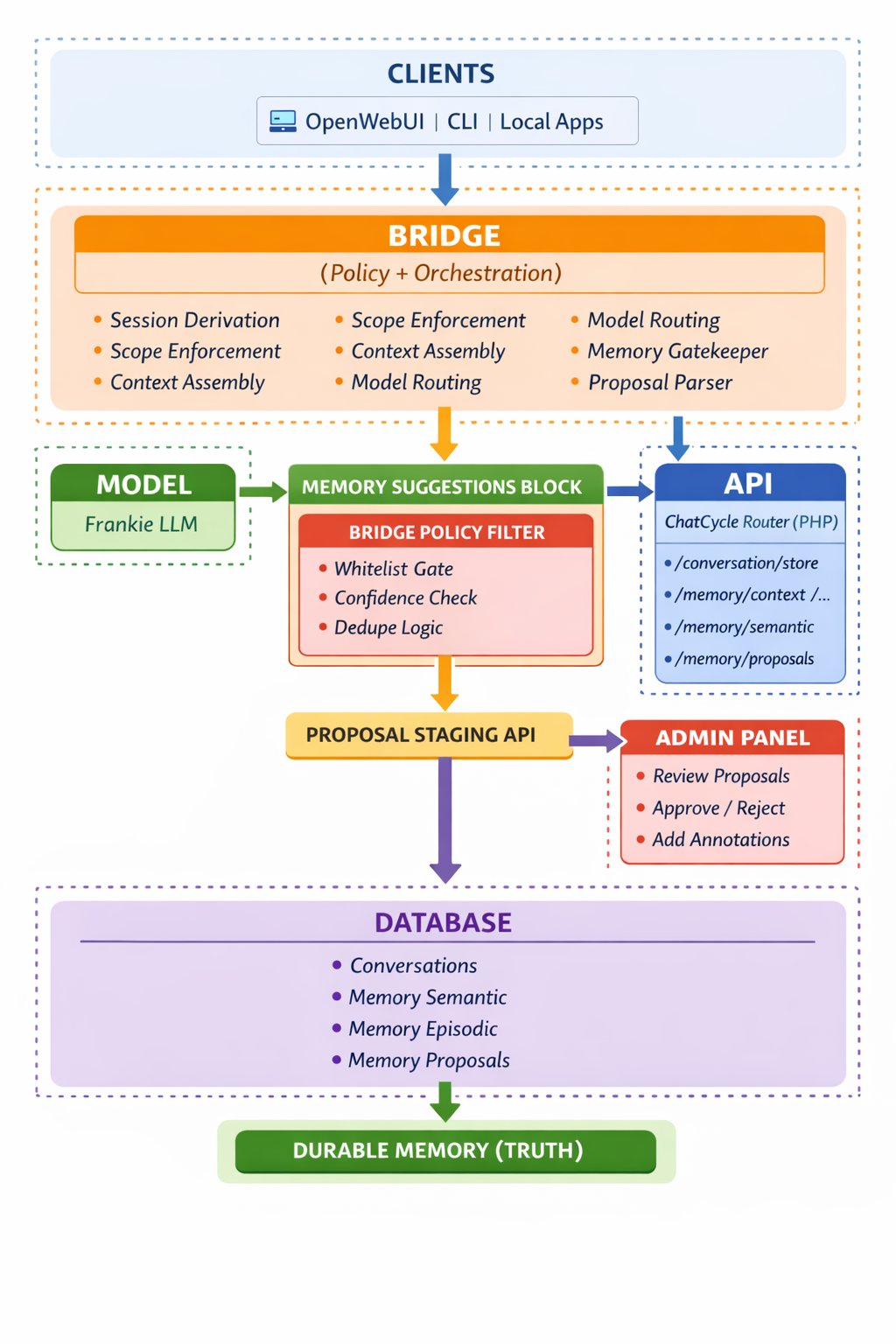
- Clients (apps, CLIs, UIs) only send and display text
- The Bridge decides:
- what context to fetch
- what memory is allowed
- what gets stored (if anything)
- ChatCycle stores memory with provenance, not assumptions
No app or model can “go rogue.”
Memory, Carefully Defined
- ChatCycle distinguishes between different kinds of memory:
- Recent Context – what we’re talking about right now
- Episodic Memory – what happened that mattered
- Semantic Memory – durable facts (stored only with approval)
- Procedural Memory – how the system should behave
Not everything is remembered.
Nothing is remembered silently.
Forgetting is a feature.
Human Control Comes First
- AI models may suggest memory
- Humans authorize memory
- Every stored memory records:
- who proposed it
- who approved it
- why it exists
- what scope it applies to
Memory without provenance is rejected.
Disagreement Is Allowed
- ChatCycle can hold:
- conflicting facts
- changing preferences
- unresolved questions
It does not force consensus.
It preserves context.
Resolution is a human act—not an automated one.
Why This Matters
Memory creates power.
Unaccountable memory creates authority.
Authority without consent creates harm.
ChatCycle exists to prevent that—quietly, deliberately, and by design.
Status
- ChatCycle is currently:
- local-first
- single-user
- modular
- intentionally conservative
Open-source components will be released once the foundation is secure.
In One Sentence
ChatCycle gives intelligent systems memory with discipline—so humans stay in control.